



How a single parenthesis in an XML feed costs e-shops thousands
Tyres for 300+ km/h and the mysterious letter Y
I own a BMW M6 E63 — a coupé with a V10 engine that can exceed 300 km/h with the M Driver's Package. I occasionally treat myself to a run on an unrestricted German autobahn, so when I was shopping for new tyres, I was naturally interested in the speed rating — the designation indicating the maximum speed a tyre is engineered for. And that's where I stumbled upon an absurdity.
Speed rating table (selection)
| Rating | Max. speed |
|---|---|
| T | 190 km/h |
| H | 210 km/h |
| V | 240 km/h |
| W | 270 km/h |
| Y | 300 km/h |
| (Y) | over 300 km/h |
The Y rating means the tyre is certified for speeds up to 300 km/h. The (Y) rating — the letter Y in parentheses — means the tyre is certified for speeds above 300 km/h. The difference between a safe and an unsafe ride at 305 km/h? Two parentheses. Why the manufacturers didn't simply pick another letter of the alphabet remains a mystery. But the real problem lies elsewhere.
The parenthesis that vanishes
When I was searching for the right tyres across Czech e-shops, I noticed something odd. On tyres that should have been listed as (Y), every single store showed just Y. No parentheses. Every e-shop I checked.
As someone about to drive over 300 km/h, I simply couldn't take the risk. If an e-shop lists the rating as Y (up to 300 km/h) instead of (Y) (above 300 km/h), how can I be sure what I'm actually buying? I couldn't. So I kept searching — shop after shop.
After a long search, I contacted one of the sellers directly. Their response confirmed exactly what I suspected:
The shop owner confirmed that the tyres indeed have a speed limit above 300 km/h and the rating should include the parentheses. However, he admitted that wholesalers don't differentiate this in their data and parameters are generated automatically without the parentheses. He acknowledged it as something to address in the future.
So the problem isn't on the e-shop's side. The problem lies in the wholesale data — in the XML feed that generates product parameters automatically. And the parentheses? They simply get lost during processing.
Why this happens and why it's a bigger problem than you think
XML feeds are structured data in a format where special characters carry meaning. Parentheses themselves aren't problematic in XML like < or >, but they pass through a chain of transformations:
1. Wholesale system → Feed generator
The original data in the internal system may contain the parentheses correctly. But during the export to an XML feed, the script strips them out — treating them as a "formatting artefact" or simply because nobody included them in the mapping.
2. Feed generator → E-commerce platform
The e-shop imports the feed and parses the parameters. If the parser doesn't expect parentheses in a speed rating value, it discards them. Only the bare Y remains.
3. E-commerce platform → Frontend
Even if the parentheses made it this far, the templating engine might escape, strip, or otherwise mangle them.
The result? The customer sees Y instead of (Y). And if that customer is someone like me — someone who needs tyres rated above 300 km/h and is willing to pay a premium — they leave.
Tyres aren't the only case
The problem of faulty feed data extends far beyond speed ratings. In our practice, we encounter a wide range of similar errors:
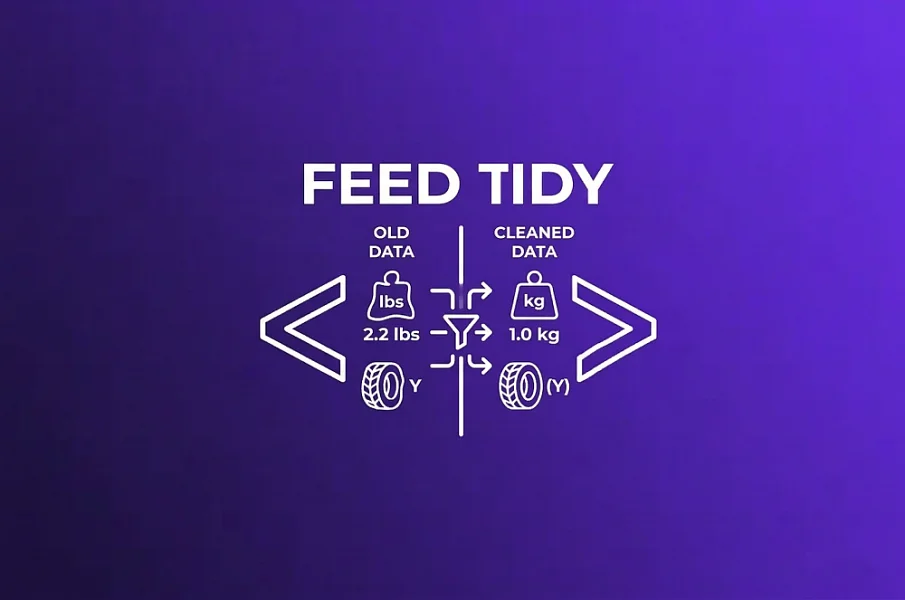
Weight units: Kilograms vs. pounds. When a US supplier sends weight in pounds and a European e-shop displays it as kilograms, the customer sees a laptop weighing "4.5 kg" instead of the actual 2 kg. Or the opposite — the product seems suspiciously light.
Product dimensions: Inches and centimetres get mixed up without conversion. A monitor with a "27" diagonal shows up as 27 cm instead of 27 inches. The customer thinks they're buying a miniature display.
Special characters in product names: Products with ampersands (&), quotation marks, or other special characters in their names break in XML feeds because these characters carry special meaning in XML. The result is truncated names, missing parameters, or completely non-functional listings.
Currencies and prices: Decimal comma vs. decimal point. In many European markets, the decimal separator is a comma; in international feeds, it's a period. A bad import can turn a price of €12.99 into €1,299 — or €1.299, which looks like over a thousand euros.
What does it cost? More than you think
Let's do the maths using the tyre example:
A set of four sport tyres with a (Y) rating typically costs up to €1,600. The customer looking for exactly this type is typically a performance car owner — a customer with higher purchasing power and lower price sensitivity. They're willing to pay 10–20% more if they're confident they're getting the right product.
When such a customer encounters an incorrect parameter, they don't complain. They simply leave. And they buy from a competitor that has the data right — even if it's hundreds of euros more expensive. That's exactly what I did.
For the e-shop, this means:
- Loss of a direct sale (hundreds of euros on a single order)
- Loss of a repeat customer (performance car owners buy tyres regularly)
- Damage to credibility (if one parameter is wrong, what else is inaccurate?)
Now imagine the same problem affecting hundreds of products in your catalogue. Feed data is automated — one systematic error replicates across the entire assortment.
The solution: AI that truly understands your feed data
A few years ago, the solution would have been hiring someone to manually review thousands of products and check parameters. Today, things are different. Artificial intelligence can go through feed data, understand it, and identify problems — including those that a person without deep knowledge of a specific product category would miss.
How does it work in practice? We take your product feed — whether XML, CSV, JSON, or any other format — and run it through an AI analysis that:
Identifies inconsistencies and anomalies. The AI doesn't just compare values against expected patterns — it understands context. It knows that a tyre speed rating can be (Y) with parentheses. It knows that a laptop can't weigh 4.5 kg when similar models in the catalogue weigh around 2 kg. It knows that a 27 cm monitor diagonal doesn't make sense.
Automatically fixes what it's certain about. Clear-cut errors — missing parentheses on a (Y) rating, wrong units, stripped special characters — the AI fixes on its own. No human intervention, no waiting. Your data is clean in minutes, not days.
Flags uncertain cases for manual review. Where the AI isn't 100% sure, it doesn't guess. Instead, it flags the issue, describes the inconsistency it found, and hands it over to a human for a decision. No blind data overwriting — you always have full control.
Learns from your data continuously. The longer the AI works with your feeds, the better it understands the specifics of your assortment. It recognises patterns typical for your industry and can distinguish a genuine error from an intentional deviation.
The result? Feed data your customers can trust. Parameters that are accurate. Filters that work. And no silent customer exits because of a missing parenthesis.
Why this is more urgent than you think
You might be thinking: "A few feed errors — that's not so terrible." But the world of e-commerce is changing dramatically right now.
People are already beginning to shop directly through AI assistants. They tell the AI exactly what they need — and it selects a specific product in a specific e-shop. The AI compares parameters, prices, availability, and data reliability. And do you know what the AI does when it encounters inconsistent data? Exactly what I did — it skips your e-shop and recommends a competitor with clean data.
In the era of AI-powered shopping, your competition isn't just other e-shops. Your competition is the quality of your data. An e-shop with clean, consistent, and complete feed data will be favoured by AI. An e-shop with errors will be silently skipped.
We'll be covering this topic in detail in an upcoming article — How AI is changing the way people shop online, and what it means for your e-shop. Follow our blog so you don't miss it.
Want to know how your feed data stacks up?
The story of a parenthesis in a tyre speed rating is just the tip of the iceberg. Feed data is the nervous system of e-commerce — and when an error creeps in, it shows up everywhere: in search, in filters, in price comparison engines, on product pages. And increasingly, in AI assistant recommendations too.
The outcome isn't just annoying returns. The outcome is silent customers — people and machines alike — who simply leave and you never find out why.
Take the first step
We offer a free initial analysis of your feed data. We'll review your feed structure, identify potential problem areas, and show you what specifically the AI can fix. No commitments — just a clear report on where your data stands.
→ Get in touch via the form at ideatech.cz and include "feed audit" in your message. We'll get back to you within 24 hours.
Or give us a call directly: +420 775 049 115.
Adam Kysel, CEO — IDEATECH, s.r.o.
Car enthusiast, BMW M6 E63 owner, and a man who spent an entire weekend searching tyre e-shops because of a single parenthesis. Today I help make sure nobody else has to.

We help you realize your ideas

Write to us
What are you interested in?
-
 +420 775 049 115
+420 775 049 115
+420 775 049 115
-
 [email protected]